Every green card has a story that started with a goodbye.
This journal exists for the people who read immigration law at midnight — not because they want to, but because they have to. We write from the waiting rooms and embassy lines, not the marble corridors where cases are decided.
Processed at Ellis Island 1892–1954
Received legal status under IRCA 1986
Active DACA recipients as of Dec 2024

"In the 1920s, Ellis Island shifts from an immigration processing station to a detention and deportation station."
— National Park Service, Ellis Island Historical Record
The Manifest and the Man Behind It
From 1892 to 1954, roughly 12 million people arrived at the Port of New York and passed through a redbrick building on a small island in the harbor. They carried manifests — ship documents filled out before departure, listing name, age, occupation, the amount of money in their pocket, and whether anyone was waiting for them on the other side. The manifest was not a welcome form. It was a legal instrument designed to determine who deserved to stay.
Between 1900 and 1914, an average of 1,900 people passed through Ellis Island every single day. Most cleared inspection in a matter of hours. But some were held for days, even weeks, while officials deliberated over a cough, a limp, the wrong answer to a question about employment. The question was always the same in different forms: will you be a burden?
Then the Emergency Quota Act of 1921 arrived, followed by the National Origins Act of 1924. The quotas were not subtle — they were designed explicitly to favor Northern and Western Europeans and to minimize immigration from Southern Europe, Eastern Europe, and Asia. Ellis Island, which had processed arrivals from across the world, became something else entirely: a detention center, a deportation station, a holding pen for people the new law had decided didn't belong.
"The manifest was not a welcome form. It was a legal instrument designed to determine who deserved to stay."
What strikes me, reading the case records now, is how little the language has changed. The 2025 H-1B regulations require petitioners to document that the beneficiary will not become a public charge. The social media review mandate — extended in December 2025 to all H-1B applicants and their H-4 dependents — is, at its core, the same interrogation the Ellis Island inspector was conducting in 1922: who are you, really, and can we trust you?
The manifest just moved online.
Historical Record
Emergency Quota Act of 1921, Pub. L. 67-5, 42 Stat. 5 — Established the first numerical limits on immigration, capping annual admissions at 3% of the number of foreign-born residents from each country recorded in the 1910 census.
National Archives Record Group 85 — Immigration and Naturalization Service ↗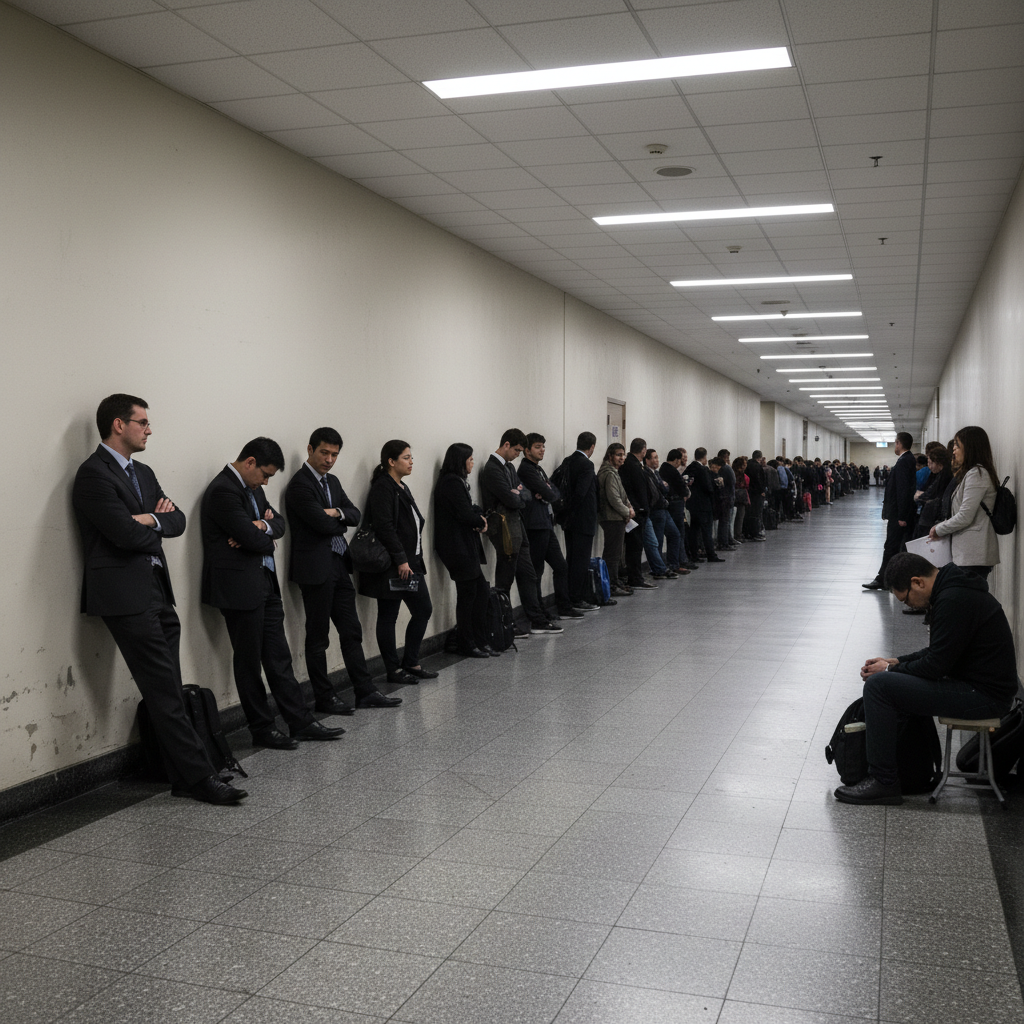
"The manifest was not a welcome form. It was a legal instrument designed to determine who deserved to stay."
People processed at Ellis Island every day during peak years, 1900–1914. Two-fifths of Americans today may be descended from them.

November 6, 1986
Reagan signs IRCA into law
"2.7 million people came out of the shadows in a single legislative act. The question the law asked was the same question it always asks: how long have you been here, and can you prove it?"
Statutory Reference
Immigration Reform and Control Act of 1986, Pub. L. 99-603, 100 Stat. 3359 (Nov. 6, 1986) — Legalization window: May 1987 to May 1988. Required continuous U.S. residence since January 1, 1982.
INA § 245A — Adjustment of Status of Certain Entrants ↗Received legal permanent status
Application window, May '87–May '88
The Year America Said: You Can Stay
On November 6, 1986, President Ronald Reagan signed the Immigration Reform and Control Act into law. History remembers it as "the amnesty" — a word that immigration hardliners still use as a slur and immigration advocates reclaim as a statement of moral fact. The law was both, and neither. It was a deal.
Under IRCA, 2.7 million people who had been living in the United States without legal status — working, paying taxes, raising children who would become American citizens — were offered a path to permanent residency. The requirement was simple in concept, brutal in practice: you had to prove you had been continuously present in the United States since January 1, 1982. You had four years of life to document in a country that had made it very difficult to exist on paper.
The application window was exactly one year: May 1987 to May 1988. You needed fingerprints, employment history, proof of continuous residency — rent receipts, utility bills, church attendance records, anything that could anchor you to a specific address on a specific date. For people who had been living carefully, invisibly, the documentation requirement was itself a kind of cruelty.
"The documentation requirement was itself a kind of cruelty — proving you existed in a country that had made it very difficult to exist on paper."
I think about IRCA whenever I read about the current administration's pause on Green Card and citizenship applications from 19 "countries of concern." The pause is indefinite. There is no announced end date, no stated criteria for resumption. 2.7 million people received legal status in 1986 because a president decided to act. Today, hundreds of thousands of people wait because a different president decided to stop.
The law is not a fixed thing. It is a series of decisions made by people with different ideas about who deserves to belong.
2025 Update
A 2025 Presidential Proclamation imposed a $100,000 fee for every new H-1B petition filed from outside the United States. A federal judge upheld the president's authority to create the fee. The IRCA application fee in 1987 was $185. The dollar amounts tell you something about who the law is written for.
The Day Before You Were Protected
On June 15, 2012 — the 30th anniversary of Plyler v. Doe, the Supreme Court ruling that barred public schools from charging undocumented children tuition — President Barack Obama announced DACA from the White House Rose Garden. Deferred Action for Childhood Arrivals. Two-year renewable protection from deportation. Work authorization. No path to citizenship. No guarantee it would survive the next election.
According to the Migration Policy Institute, more than 1.3 million U.S. residents were eligible for DACA as originally implemented. As of December 31, 2024, there were 533,280 active recipients. The gap between those numbers is a story in itself — people who aged out, people who couldn't afford the renewal fee, people who were afraid to submit their address to a federal agency, people who simply gave up.
About 80% of current DACA recipients arrived in the United States when they were 10 years old or younger. This means that for most of them, the country they might be deported to is a country they don't remember, a country they may not speak the language of, a country their parents left because it was not survivable.
This is where the story reaches you
If you're reading this at 2 a.m., refreshing the USCIS case status page, I want you to know that the anxiety you feel is not irrational. The system is designed in a way that makes certainty impossible. DACA must be renewed every two years. The H-1B lottery for the 2026 cycle opens March 4, 2026 and closes March 19, 2026 — fifteen days to determine a year of your life. An indefinite pause on asylum adjudications went into effect in 2025. The Refugee Admissions Program was suspended January 27, 2025.
These are not abstractions. These are deadlines, and behind each deadline is a person who needs to know what comes next.
The Dignity Act of 2025, introduced by Rep. Maria Elvira Salazar on July 15, 2025, proposed a bipartisan path: legal status for undocumented individuals, border security measures, updated immigration law. It has not passed. It may not pass. But its existence is evidence that the argument is not over, that the door is not fully closed, that the law — slow, imperfect, infuriating — remains a place where human outcomes are still being negotiated.
That's why this journal exists. Not to give you legal advice — we're not your attorneys. But to give you the one thing that's sometimes harder to find than a good lawyer: the sense that someone is paying attention, that your situation has a history, and that history is worth understanding.
Precedent
Plyler v. Doe, 457 U.S. 202 (1982) — Supreme Court held 5-4 that a Texas statute withholding state funds for educating undocumented children violated the Equal Protection Clause of the Fourteenth Amendment.
DACA Policy — DHS Memorandum, June 15, 2012 ↗
533,280
Active DACA recipients, Dec 31, 2024
"80% of DACA recipients arrived when they were 10 years old or younger. The country they might be deported to is one they don't remember."
Originally eligible for DACA
Renewal cycle — no guaranteed continuity
"The H-1B lottery window for 2026: March 4–19. Fifteen days to determine a year of your life."
Current Status — 2025
- Asylum adjudications: indefinitely paused
- Travel bans: ~40 countries affected
- Refugee Admissions Program: suspended Jan 27, 2025
- H-1B social media review: all applicants + H-4 dependents
Three chapters.
Hundreds more are waiting.
The archive covers H-1B policy changes, DACA litigation, asylum procedure, green card backlogs, and the human stories inside every case number. Every piece is written for the person living through it.
"I forwarded the DACA renewal piece to every Dreamer I know. Finally something I could share with my parents that didn't feel like a legal memo."
Valentina Restrepo
DACA Recipient, Chicago
"I've been on H-1B status for six years. This is the first publication that writes about the lottery like it's a human experience, not a policy debate."
Arjun Mehta
Software Engineer, Seattle
"My clients ask me to recommend reading. I send them Passage. The legal accuracy is sound and the humanity is intact."
María Guadalupe Torres
Immigration Attorney, Houston